
The Conflict
Posted by
Martim Barata
|
Posted in
|
Posted on
15:59


Howdy-hi. Tonight I come to you with a more sensitive topic: emotionality. It allows people to be in sync with other's emotions, and respond accordingly. It forms bonds, eases suffering, motivates, depresses, transforms. Emotionality is, in essence, that which allows one to connect with another, to trust.
I've never been a very emotional person - or, let me rephrase that, I've never had many of the benefits emotionality has to offer. Mainly the downsides. I get depressed somewhat easily, my mind is a ticking time-bomb for nervous breakdowns, and I'm pretty sure I'm paranoid (everyone who's out to get me told me so). What this means is I'm not easily motivated, am almost completely useless at cheering someone up and alienate many people I meet. Most of all, I rarely trust anyone.
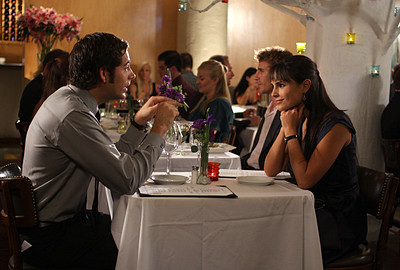
Watching Chuck has really warped my brain, as far as trust goes. Imagine if anyone you knew, anyone at all, could be an undercover agent trying to get you killed or imprisoned. The show is NBC's version of paranoia. It does get you thinking though... how far can you trust someone?
Everyone has a brain (despite many's best attempts to prove otherwise) that tells them to look out for themselves. It's human nature to want the best for you and the rest for others, and that almost always interferes with keeping your word. If you've promised not to tell a secret, the social interaction that comes with revealing it to someone can cause you to crack; if you've promised to do something, the stress and trouble you have to go through to do so can make you skip it; basically, there's always reason not to fulfil a promise - otherwise, why would you need to promise it, right?
Having a long-lasting bond with someone may contribute a great deal to being able to trust that person, but not necessarily, though. Even best friends can be blabbermouths. Telling someone your deepest, darkest secrets is leaving yourself so vulnerable and open that it may not be worth the risk. Life isn't a Disney movie - who of you readers can honestly say they have a completely trusting relationship with someone else? Even if you are sleeping with them, I'm willing to bet you don't tell them EVERYTHING.

It's a matter of power balance, I guess. Revealing more about yourself than you normally would can end up leaving you feeling rejected and weak, unless the other person does the same. In today's dynamic of high-speed relationships were the whole world works basically like a speed-dating convention, very few people are able to build a connection with someone else that grows to the magnitude of complete trust. I see less and less best friends in the people around me, and relationships with more and more issues because of this.
Having that said, it takes a great deal of trust to be sure that someone will overcome these odds and come through for you. I can honestly say that, outside of family, the number of people I completely trust is a divisor of 2. And even within the family, there is a strong hierarchy as far as trust is concerned. There are a few I wouldn't trust more than my dog (and she knows too much).

I'm a very pessimistic person, I hate having high hopes because dissapointment is a bitch. I'm not necessarily a realist, as many pessimists claim to be, so I may be wrong about this, but tell me readers, what drives you to trust another? I'm actually very interested in your responses, because though it may appear otherwise (thanks to my brilliance), I only have access to my view on the world.
Back to the ol' farming-board.
The Cap'n
Aw. So true. Today we barely can trust someone from work, school, etc. Today they can be your best friends and you think you can tell them everything about you...and tomorrow they're using that information as blackmail. However, and thankfully, not everyone in this world it's like this. Keep up with the good work mate! ;)
I trust people that don't trust me.
I don't actually try to do one liners, but damn I'm good.
You often place trust on people who most likely don't trust you, not saying this covers 100% of the cases, but probably you are more prone to understand someone if they don't fully like you.
This applies mostly to policemen, doctors, firemen, shrinks, lawyers in a professional level, mainly 'cause (and despite badmouthing them behind their back) you will likely give out full professional trust to them.
Same thing applies emotionally, You trust your mother to look out for your best interest, and chances are no mother will ever trust you for the same, same goes for relationships and friends, where you trust them to know better then you.
This of course creates a paradox, if friends are supposed to trust the other one not trusting them, which one is the one trusting and which one is the one dubious and backstabbing? Answer is both of them are, growing up gives you a code or dogma to which you follow and based on that, you crate a circle of friends, and for this circle to work, the people in need probably share (in some form) the same code or dogma, and thus you trust everyone in your circle to look out for you and guide you when you fuck up, like they expect you to do the same.
They trust you, to not trust them, and vice versa.
I had a hard time following your logic but I think I got it down.
As far as the cases where "professional trust" is envolved, that's not necessarily true... many times people will lie or omit certain facts simply because they aren't at ease with the professional. It's actually unlikely you'll give any professional your full trust, especially if you have something to hide. As House would say, everybody lies, right?
Having a bond that relies on believing the other will look out for you is essentially the ideal trust link. Basically "you trust them to not trust you" means you expect your friends to question your actions and try to help out when they believe you're in a rough place. I don't think everyone sees this way, though. In fact, many people may prefer a friend who will support someone even when they may not be making a right choice in their eyes, and be there for them whether they succeed or not.
There's nothing more annoying than someone offering unwanted advice. It all depends on what kind of person you are - some people may rely on their friends for advice, others for support, and others may just rely on them for entertainment. In the first case, your description fits perfectly - not so much in the others.
I ask a doctor to look at my genital wart with hopes that he can cure it, he'll ask me "wtf?" and I'll most likely lie, and he will know I'm lying, but will help me anyway.
You trust him to do his job, he never trusts you, same goes for basically every profession with a more social interaction. Thats professional trust.
On the other thing. Yeah, probably most people rather be supported on their decision, or simply trust them in a way that they know whats "okay to say" and whats "not cool". But I find it very hard to grasp that, personally, it just seems too easy to trust someone just because they nod their head at what you say, or because they entertain you. I don't like that, don't see those people as part of the social circle I'd call my friends.
Maybe this can be clearer with my reaction over a twat that gave up university, I'm clearly against it and say he is a twat because he is my friend, I don't trust he is doing the right choice, but does this mean I don't support the twat? Or that I'm no longer friends with the twat? No, it just shows there is a link of trust that goes stronger then your everyday joe.
Probably what I'm saying is that you can support anyone you see on the street, and you can easily be sociable enough to entertain anyone, but to actually have a bond of trust and call someone a friend you need to go a bit further than that.
I add that, more commonly then not, I see people desperately being content by just having the first two and being oblivious to the third.
This is obvious in people that crave attention, and this is fucked up when this person realizes that the people he was doing the chicken dance for, aren't actually his friends because they, just, don't, care.
Why genital wart man? So many examples you coulda gone to... xD Anyway, professional trust, as we've defined it, has no depth, you depend on someone else to perform their social function so that you can perform yours.
The subject seems to have drifted onto what friendship is, although it was implied in the post. I'm trying to find counter-arguments in order to prolong the discussion but I feel like I agree with what your saying. It would actually be enough to make another post, but since we're covering it here there doesn't seem to be a great deal of a point.
Basically, a good friend will call you out on your crap, support your decisions when they're final, hang out and be there when needed. Generically, at least. Good session, people. Although I wish more readers would post :C
Trust other people? Can you trust yourself?
Fair enough.